
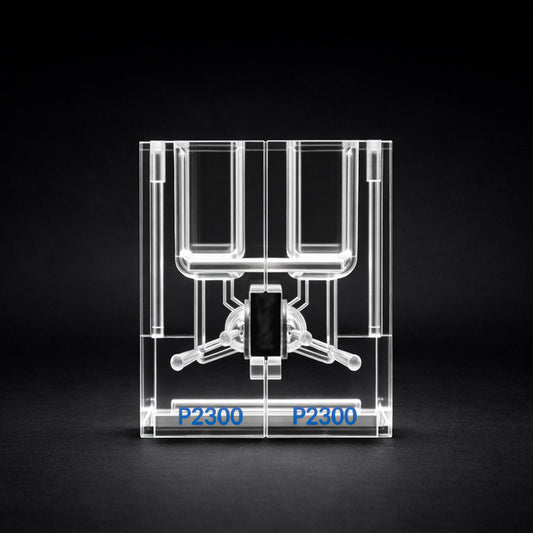

TEER Plates vs Franz Diffusion Cells vs Ussing Chambers

Methods • Barrier Function • Permeability • Functional Physiology
Scientists search "TEER vs Franz vs Ussing chamber" when they need a method choice they can defend—to reviewers, internal decision gates, or regulated testing frameworks. This guide compares the tools the way scientists evaluate methods: what each output represents, what controls make the data credible, and when an Ussing chamber is the justified platform purchase.
These tools do not measure the same phenomenon. TEER (transepithelial electrical resistance) is an electrical integrity/stability signal. Diffusion cells (e.g., Franz) quantify passive permeation kinetics. An Ussing chamber adds time-resolved functional electrophysiology (baseline → dosing → washout → recovery) so you can interpret what changed, how it changed over time, and whether the tissue remained physiologically credible while it happened.
Practical takeaway (platform decision)
If your lab repeatedly needs mechanism, directionality, and time-resolved interpretation (onset → peak → recovery), an Ussing chamber is often the purchase that upgrades the entire barrier/transport program. TEER and diffusion remain valuable supporting tools, but they do not replace functional physiology.
What scientists are actually trying to answer
Method selection becomes straightforward once you state the study goal as a measurable claim. Most "barrier and transport" programs reduce to two buckets:
-
Integrity and stability of the barrier
Can the tissue/culture form and maintain an intact barrier under your conditions? Is it stable over the full time window? If something changes, can you argue it is biology rather than drift, handling, or mounting artifact? -
Movement of a molecule across that barrier
How much of a specific compound crosses over time under defined donor/receiver conditions, and with what kinetics? Is transport consistent with passive diffusion, or does directionality and physiology matter?
Problems start when a team tries to answer both buckets with a single endpoint. A single integrity number does not define solute transport behavior, and a permeation curve does not automatically prove the tissue remained stable while it was generated. The most defensible workflows match the method to the claim and add functional context when interpretation is the limiting factor.

Barrier questions (integrity, stability, reversibility)
-
Is the barrier intact, or failing early?
What matters is not only the initial value, but baseline stability and whether the barrier holds under dosing and time. -
Is a change reversible (functional stress) or irreversible (injury)?
Recovery after washout supports reversible modulation; progressive loss without recovery suggests compromise. This changes how you interpret "improved flux." -
Is a TEER shift physiology, or conditions?
TEER is sensitive to equilibration time, temperature, solution composition, electrode placement, and geometry. Without stability criteria, a TEER "effect" can be an artifact. -
Does the barrier remain stable long enough for long permeation runs?
If integrity drifts mid-run, your flux curve can become a mixture of stable-barrier transport plus failure-mode transport—hard to defend.
Transport questions (flux, directionality, mechanism)
-
Is transport purely passive diffusion, or is physiology participating?
Time dependence, sidedness, and perturbation responses often signal more than diffusion. -
Do you need apical → basolateral directionality (and the reverse)?
If the claim depends on sidedness, directionality is not optional—it's part of the question. -
Did flux increase due to enhancement or compromise?
Higher flux can be a success (controlled enhancement) or a failure (barrier disruption). Without functional context, both narratives can fit the same curve. -
Can mechanism be supported with controls?
Mechanism requires stable baseline, predictable kinetics, and control perturbations consistent with a defined process (not post-hoc interpretation).
Why TEER-only or diffusion-only programs stall
TEER-only stall: TEER is an integrity/stability signal—not a solute-specific transport explanation. TEER can be highly sensitive to small shunts/edge effects and measurement conditions, so disagreements can become interpretive rather than mechanistic.
Diffusion-only stall: you get a permeation curve, but it can be hard to prove what happened to the tissue while that curve was generated. Flux is cumulative; enhancement and compromise can both raise apparent permeation.
Decision risk: when endpoints conflict, teams lose time debating the assay instead of concluding the biology. Adding continuous physiology reduces ambiguity and improves defensibility.
What each method measures (and why that matters)
A credible methods page names the actual outputs and what they represent. Many "comparison" articles fail because they describe tools as if they measure the same thing. They do not.
Key outputs and definitions (what the numbers actually are)
| TEER / TER (Ω·cm²) | Area-normalized electrical resistance. Useful as an integrity/stability indicator; not a direct measurement of chemical permeability for a specific solute. |
| PD (mV) | Transepithelial potential difference (open-circuit conditions). |
| Isc / SCC (µA/cm²) | Short-circuit current (net electrogenic ion transport when clamped). Supports mechanistic physiology when paired with controls and stability criteria. |
| Q(t) | Cumulative amount transported vs time (diffusion studies). |
| J (flux) | Transport rate per area (e.g., µg/cm²/h), computed over a defined time window. |
| Kp / Papp | Derived permeability parameter; definition and calculation depend on model and conditions—state formula, window, and units. |
| Method | Primary outputs | What the outputs represent | What it cannot tell you (alone) |
|---|---|---|---|
| TEER plate / meter | Resistance (Ω); TEER (Ω·cm²) | Electrical resistance (ionic conductance behavior) across an epithelial layer under defined conditions. Strong for integrity gating, stability checks, and routine QC. | Solute-specific flux/permeation, directionality, or mechanism. A TEER change is not automatically a permeability change. |
| Diffusion cell (e.g., Franz) | Receiver concentration vs time; Q(t); flux J; permeability metrics | Passive permeation/penetration kinetics across skin or explants under defined donor/receiver conditions. Standardized in vitro skin absorption guidance (e.g., OECD TG 428) recognizes diffusion cell approaches including static and flow-through designs. OECD TG 428: Skin Absorption: In Vitro Method |
Continuous functional physiology (baseline stability, reversible vs irreversible effects) and mechanistic tie-breakers. A permeation curve alone does not prove enhancement vs compromise during the run. |
| Ussing chamber | PD, Isc/SCC, resistance/conductance over time; optional directional flux | Time-resolved functional electrophysiology during dosing and recovery—supports stability criteria, reversibility assessment, and mechanistic interpretation. Can be paired with unidirectional/bidirectional flux to quantify transport with functional context. | Not optimized for highest-throughput screening or lowest per-sample cost compared to TEER plates. It is a physiology platform—best used when interpretation quality and defensibility matter more than throughput. |
TEER vs diffusion vs Ussing (decision snapshot)
| Capability | TEER Plate | Diffusion Cell (Franz) | Ussing Chamber |
|---|---|---|---|
| Best for | Integrity/stability gate; QC | Passive permeation kinetics | Mechanism + time-resolved physiology |
| Time resolution | Intermittent checks | Discrete sampling over time | Continuous monitoring (plus optional flux) |
| Directionality | No | Yes (donor → receiver design; passive) | Yes (protocol-dependent; supports active/passive interpretation) |
| Mechanistic leverage | Low | Low (flux only) | High (kinetics + recovery + perturbations) |
| Early instability detection | Moderate (conditions-sensitive) | Low–moderate (often detected late) | High (functional signatures + recovery) |
| What it misses | Mechanism/directionality | Physiology during the run | Throughput, simplicity, lowest per-sample cost |
Why labs upgrade to an Ussing chamber system
If your lab is building a barrier and transport capability (not just running a single experiment), the limiting factor becomes interpretability and defensibility. The fastest way to waste months is to run assays that produce "clean-looking" endpoints while leaving you unable to distinguish mechanism from artifact.
This is why labs upgrade: an Ussing chamber system turns endpoint reporting into physiology-based interpretation. It lets you document baseline stability, capture response kinetics during dosing, and determine whether the preparation recovers after washout. That time-resolved context is often the difference between a defensible mechanistic conclusion and a debate over what an endpoint "means."
An Ussing chamber system helps answer the question behind the question: did the tissue behave like tissue, or did the preparation drift or fail? Continuous electrophysiology makes instability visible in real time—so you can separate true transport effects from compromised preparations.
What you gain scientifically
- Time-resolved physiology: follow baseline → dosing → washout → recovery (supports stability criteria and reversibility).
- Mechanism support: pair functional signals with controls (time course, inhibitors, ion substitution) to strengthen interpretation.
- Reduced ambiguity: separate enhancement from injury using kinetics and recovery behavior rather than post-hoc narrative.
When it becomes "necessary"
- TEER and flux repeatedly conflict and you need a physiologic tie-breaker (not rhetorical interpretation).
- You need directionality or functional components, not just passive diffusion.
- You are publishing mechanistic claims and need conclusions that survive scrutiny.
- You need differentiation in a lab/CRO offering beyond standard TEER + diffusion endpoints.
A realistic way to think about it
TEER is a screening gate (fast integrity/stability checks). Diffusion cells quantify passive permeation (receiver kinetics, flux, permeability). Ussing is the physiology platform you buy when the decision requires mechanistic defensibility, directionality, and time-resolved interpretation.
Worked interpretation example (topical & barrier programs)
A common outcome is this: you dose a formulation and receiver-side concentration increases faster than control. In diffusion terms, that looks like higher apparent flux (and often higher calculated permeability). The easy statement is "permeation increased." The defensible question is: what caused the increase, and did the tissue remain credible while it happened?
Interpretation A — enhancement (desired):
Increased effective driving force without harming the barrier (e.g., improved solubilization at the interface, increased partitioning into the tissue, or mass-transfer effects).
Interpretation B — compromise (undesired):
Barrier integrity degrades over time (leak pathways, junctional disruption, injury), producing higher apparent flux that is not a controlled "delivery improvement."
Why flux alone can't resolve this: diffusion curves are integrated endpoints. They can look smooth even if the tissue is progressively destabilizing. Sampling frequency and analysis windows can hide time-dependent failure.
How functional electrophysiology makes the interpretation decision-grade: continuous monitoring during baseline, dosing, washout, and recovery gives you baseline stability evidence, onset kinetics, recovery behavior, and a transparent exclusion framework when the preparation becomes unstable. That sharply reduces the risk of mistaking injury-driven leak for enhancement.
Functional physiology does not "prove safety" or "prove enhancement." It provides the missing context that lets you defend which interpretation the data support.
Controls and reporting checklist (what reviewers look for)
- Area normalization: report TEER as Ω·cm² when appropriate; state exposed area; document blank/membrane handling.
- Baseline stability: define a stabilization window and a drift threshold before dosing (do not report transient handling artifacts as biology).
- Condition control: temperature, solution composition, equilibration time, and mixing/stirring must be controlled and reported.
- Mounting/leak artifacts: document how edge leaks and damaged samples were identified/excluded (especially for skin/explants).
- Diffusion details: donor/receiver compositions, sink conditions, sampling schedule, analytical method, and calculation window for flux/permeability.
- Electrophysiology details: open-circuit vs short-circuit mode, electrode calibration/offset handling, and acceptance criteria for baseline stability.
- Replicates + exclusions: predefine exclusion criteria; report n, exclusions, and reasons transparently.
Recommended workflows (how strong programs actually run this)
| Screening / QC | TEER to confirm barrier formation + day-to-day integrity gate (proceed / do not proceed). |
| Passive permeation deliverable | Diffusion cell kinetics (flux/permeability) with clear sink conditions, sampling plan, and calculation window. |
| When endpoints disagree | Add Ussing physiology to document baseline stability, dosing response kinetics, and recovery (tie-breaker rooted in physiology). |
| Mechanism / directionality claim | Ussing as primary platform; diffusion/TEER become supporting endpoints (triangulation rather than single-endpoint claims). |
Which method should you choose?
| If your question is… | Choose… |
| "Is my barrier intact and stable enough to proceed?" | TEER (integrity/stability gate; QC) |
| "How much crosses passively through skin/explant over time?" | Diffusion cell (e.g., Franz) for permeation kinetics |
| "Why is it changing (mechanism, directionality, reversibility)?" | Ussing chamber (functional physiology + time course; optional flux) |
| "What should my lab buy for decision-grade barrier physiology?" | Ussing chamber as the core platform; TEER/diffusion as supporting tools |
Companies that could benefit are: Episkin

FAQs
1) Does TEER predict permeability?
Not reliably. TEER measures electrical resistance (ionic conductance under the measurement conditions). Permeability is a chemical transport outcome for a specific solute and depends on solute properties, partitioning, diffusion through layers, and donor/receiver conditions (sink, stirring, composition, temperature). Treat TEER as an integrity/stability indicator—not a standalone predictor of solute flux.
2) Why can TEER drop without a matching increase in flux?
TEER can respond to early/localized changes (or measurement conditions) before bulk solute transport changes detectably. Small shunt-like defects can lower electrical resistance while having limited impact on whole-area solute flux within your assay's sensitivity and time window. A TEER drop should trigger stability checks, leak exclusion logic, replication, and (when needed) functional context.
3) Why can flux increase when TEER looks stable?
Flux can be dominated by partitioning/solubility, donor/receiver sink conditions, route-specific behavior that TEER is relatively blind to, and boundary-layer/mixing effects. These can raise chemical transport without meaningfully changing ionic conductance.
4) When is a Franz diffusion cell the correct primary method?
When your primary endpoint is passive penetration/permeation across skin or explant and you need receiver-compartment kinetics over time to derive flux/permeability metrics. Diffusion becomes insufficient as a standalone tool when you must defend stability, reversibility, directionality, or mechanism.
5) What does an Ussing chamber add beyond TEER?
Continuous functional context. Instead of a single integrity checkpoint, you get time-resolved signals during dosing, washout, and recovery. That supports mechanistic interpretation, stability criteria, reversibility assessment, and stronger Methods defensibility.
6) Can Ussing chambers support permeability/flux work?
Yes. Many labs pair tracer/solute flux with electrophysiology so flux is interpreted with functional context. The benefit is measuring transport while simultaneously tracking stability and recovery—reducing ambiguity about whether flux reflects enhancement vs compromise.
7) What do reviewers look for in Methods?
Clear reporting of normalization, baseline stability criteria, temperature/solution control, mounting geometry, sink and sampling conditions (for diffusion), calculation windows/units, and how artifacts/leaks were excluded. Conclusions get challenged when controls and reporting cannot support the strength of the claim.
8) What is the most common reason barrier data gets challenged?
Over-claiming from a single endpoint. TEER alone is not "function," and flux alone is not "viability." Strong studies triangulate—pairing integrity and flux and adding time-course/recovery context plus explicit exclusion criteria.
9) When is TEER alone sufficient?
When you need a fast integrity gate (barrier formation, routine QC, relative screening) and you do not need directionality or mechanism. Once your conclusions require "why," "which direction," or "did it recover," TEER is no longer sufficient by itself.
10) When is buying an Ussing chamber justified?
When your lab needs publishable, decision-grade mechanistic barrier physiology and TEER-only or diffusion-only workflows keep creating interpretation risk. Typical triggers are persistent TEER/flux conflicts, the need for directionality and time-resolved interpretation (onset → peak → recovery), and the need to separate true transport enhancement from tissue compromise. If these issues recur across projects, an Ussing chamber becomes a core platform purchase.
11) What acceptance / stability criteria should be defined before dosing?
Define (and report) a baseline window where the preparation is demonstrably stable before you dose. "Stable" should be operationalized as: (a) minimal drift in TEER/TER and (if using Ussing) resistance/conductance over a defined period, (b) absence of obvious shunt behavior (sudden step changes or progressive collapse), and (c) confirmation that the mounting area and edges are intact (no edge leak indicators). The exact thresholds are model-specific; what matters scientifically is that you predefine the criteria and apply them consistently across groups.
12) How do you rule out edge leak vs true barrier modulation?
Edge leak is a common failure mode that can mimic "enhanced transport" or "barrier opening." Rule-out requires both technique and reporting: document the exposed area and mounting geometry; report how you inspected/validated seals; apply exclusion criteria for preparations showing abrupt resistance collapse or non-physiologic instability; and when possible, interpret flux changes alongside continuous integrity/physiology data (baseline stability + recovery behavior). If a preparation cannot maintain stability through dosing and washout, treat the result as compromised rather than mechanistic.