

Ussing Chambers vs. TEER Plates: When and Why to Use Each

Not sure whether you need TEER, an Ussing chamber, or both? Epithelial researchers often use the two terms in the same sentence, but they answer different biological questions. This guide explains those differences in clear language and shows how Ussing chamber systems from Physiologic Instruments can extend what you already do with TEER.
Why Ussing Chambers and TEER Plates Get Confused
Both techniques measure electrical properties across an epithelial layer. Both are used to study barrier function, transport, and injury. But they are built for different sample types and different questions.
- TEER plates are optimized for cell monolayers in multiwell formats.
- Ussing chambers are optimized for detailed transport studies in tissue, organoids, and monolayers.
Understanding what each system actually measures makes it much easier to choose the right tool for your next experiment.
What an Ussing Chamber Actually Measures
From voltage to ion transport
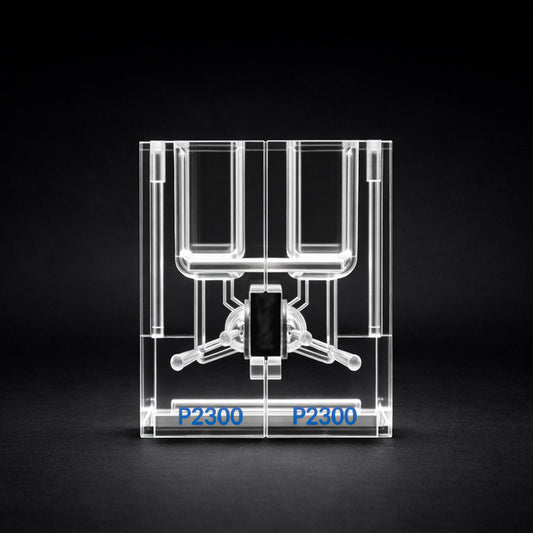
An Ussing chamber mounts an epithelial sheet between two half-chambers, separating the apical and basolateral sides. Electrodes and a voltage/current clamp measure and control the transepithelial potential.
- Transepithelial voltage (Vte) – the electrical potential difference across the tissue.
- Short-circuit current (Isc) – the net ion transport required to clamp Vte at zero.
- Resistance / conductance – an electrical estimate of barrier tightness.
By changing solutions and adding pharmacologic agents, Ussing experiments can dissect specific transport pathways such as CFTR-mediated chloride secretion, ENaC-mediated sodium absorption, and electroneutral transporters.
When Ussing chambers are the better choice
- Primary tissues (intestinal, airway, colon, urinary, reproductive tracts).
- Opened organoids or tissue sheets that cannot be measured in standard TEER plates.
- Cell monolayers when you need more than a single resistance value.
- Mechanistic studies of ion channels, transporters, and drug response.
Modern multi-channel systems, such as the EasyMount Ussing Chamber Systems from Physiologic Instruments paired with voltage/current clamps and Acquire & Analyze software, allow multiple tissues to be studied simultaneously with tight control of temperature, gas, and solution composition.
What TEER Plates Actually Measure
Resistance as a readout of barrier integrity
Trans-epithelial electrical resistance (TEER) is a relatively simple measurement. A small alternating or direct current is passed across a monolayer grown on a permeable support, and the resulting voltage drop is used to calculate resistance.
In practical terms:
- Higher TEER → tighter barrier / less paracellular leak.
- Lower TEER → leakier barrier / disrupted tight junctions.
TEER plates are ideal for tracking how a monolayer forms, differentiates, and responds to injury or treatment over time.
Where TEER is the better tool
- Cell lines such as Caco-2, Calu-3, T84, MDCK, and others.
- High-throughput screening of cytokines, drugs, toxins, or formulations.
- Routine quality control of monolayers before transport or permeability assays.
- Longitudinal experiments lasting hours to days.
However, TEER does not tell you which transporters or channels are responsible for a change in resistance, and it is not well suited for intact tissues or complex 3D structures.

Side-by-Side Comparison: Ussing Chamber vs. TEER Plate
| Feature | Ussing chamber | TEER plate |
|---|---|---|
| Primary readout | Vte, Isc, resistance / conductance | Electrical resistance (TEER) |
| Main question answered | Which ion transport pathways are active and how they respond | How tight or leaky is the epithelial barrier |
| Compatible samples | Primary tissues, opened organoids, monolayers on inserts | Cell monolayers on permeable supports |
| Throughput | Low–medium (multi-channel systems) | Medium–high (24/96-well formats) |
| Experiment time scale | Minutes to a few hours | Minutes to several days |
| Mechanistic insight | High — can dissect specific channels/transporters | Low — barrier status only |
| Solution control | Independent apical and basolateral composition | Limited in standard plate formats |
If you need to know “which transport pathway changed and why?” you need an Ussing chamber.
When TEER Is Not Enough
Imagine a treatment that increases TEER by 20 percent. You know the barrier is tighter, but you do not know whether the effect is due to:
- changes in tight junction proteins,
- altered paracellular ion selectivity, or
- changes in active ion transport that indirectly influence resistance.
An Ussing chamber allows you to apply specific inhibitors and activators to separate these possibilities. By looking at Isc traces, you can identify whether channels such as CFTR, ENaC, or CaCC are responsible for the response.
When an Ussing Chamber Is Overkill
There are many situations where TEER alone is the practical and efficient choice:
- Screening dozens of compounds for barrier toxicity or protection.
- Monitoring monolayer formation day by day.
- Running routine QC to make sure cell culture conditions are stable.
Think of TEER as the tool that keeps your cultures honest and your throughput high. Your Ussing rig is where the most interesting conditions go for detailed mechanistic study.
Using TEER and Ussing Together: A Simple Workflow
- Grow monolayers on permeable inserts. Follow TEER until a predefined threshold is reached.
- Screen conditions with TEER. Remove clearly toxic or ineffective treatments.
- Move selected inserts into an Ussing chamber. Study ion transport under controlled conditions.
- Apply pharmacologic tools. Use blockers and agonists to map the roles of specific channels and transporters.
This combined approach increases reproducibility and protects time on your Ussing system for the most informative experiments.
Where Physiologic Instruments Fits In
Physiologic Instruments focuses on Ussing chamber systems designed for detailed epithelial transport research. Our EasyMount Ussing Chamber Systems, P2300-style tissue chambers, and voltage/current clamps integrate with Acquire & Analyze software to provide stable measurements of Vte, Isc, and resistance across multiple tissues in parallel.
If your lab already uses TEER plates, adding an Ussing system gives you the ability to move from simple barrier measurements to full transport characterization without changing your overall cell culture workflow.

Frequently Asked Questions
Can I use TEER plates instead of an Ussing chamber?
TEER plates are excellent for monitoring barrier integrity in monolayers, but they cannot provide detailed information about individual ion channels or transporters. If your main question is “how tight is the barrier,” TEER alone may be enough. If you need to understand transport mechanisms or study intact tissues, an Ussing chamber is the appropriate tool.
Can I move TEER inserts directly into an Ussing chamber?
Yes, many labs culture cells on inserts, track TEER, and then transfer the same inserts into Ussing chambers. This approach lets you use TEER as a screening and QC step before performing more complex transport measurements.
What sample types are not suitable for TEER but work in Ussing chambers?
Intact tissue sheets (for example, intestinal mucosa, airway epithelium, and colonic tissue) and opened organoids cannot easily be measured in standard TEER plates, but they can be mounted in appropriately sized Ussing chambers such as the P2300-style chambers used in our EasyMount systems.
Do I always need both TEER and Ussing for a good study?
No. For some projects, TEER alone or Ussing alone is appropriate. However, combining TEER for screening and QC with Ussing for mechanistic follow-up often produces the most robust data set, especially in translational or pharmacologic studies.
How much training is needed to start using an Ussing chamber system?
Researchers familiar with cell culture and TEER usually adapt quickly to Ussing experiments. Physiologic Instruments provides documentation and support to help new users choose chambers, design protocols, and interpret electrical data so they can progress from simple measurements to confident mechanistic studies.
Take-home message
TEER plates are ideal for monitoring epithelial barrier integrity and running higher-throughput screens. Ussing chambers are ideal for dissecting ion transport mechanisms in tissues, organoids, and monolayers under tightly controlled conditions. Using both together allows your lab to move from simple resistance measurements to a complete understanding of epithelial transport.
If you are ready to extend your TEER-based studies into mechanistic transport research, the team at Physiologic Instruments can help you choose an Ussing chamber system that matches your samples and experimental goals.