
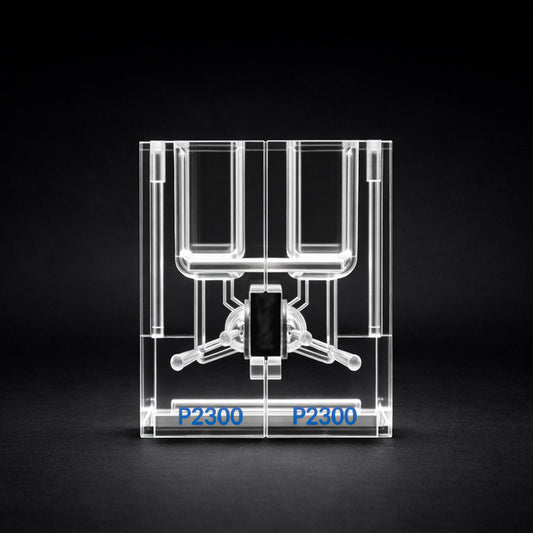

Best Ussing Chamber Buffers and Gassing (2026): Bicarbonate vs HEPES, CO₂ Control, Osmolarity, and pH Stability

Buffer choice and gassing are the fastest ways to make Ussing chamber data look “mysteriously unstable.” Most baseline drift, noisy traces, and non-reproducible responses come from predictable chemistry and handling problems: CO2 mismatch, pH control that does not match the buffer system, osmolarity differences between sides, bubbles, and temperature gradients. This guide explains how to choose bicarbonate or HEPES buffering, how to gas correctly, and how to prevent pH drift and unstable baselines.
What most people mean by “stable Ussing chamber conditions”
- pH stays in a physiologic range over the full run, not just at the start.
- Osmolarity is matched between mucosal and serosal sides unless your protocol intentionally creates a gradient.
- Gas delivery and mixing are consistent, no intermittent bubbling or dead zones.
- Temperature is controlled and does not drift during solution changes.
- Electrode environment is consistent, including solution composition and junction stability.
Bicarbonate vs HEPES, choose the system that matches your CO₂ reality
| Decision point | Bicarbonate buffered solutions | HEPES buffered solutions |
|---|---|---|
| How pH is controlled | Primarily by CO2 partial pressure (gas composition and delivery consistency) | Primarily by buffer capacity at ambient CO2, less dependent on gassing |
| When it is the best choice | Physiologic workflows that rely on bicarbonate chemistry and CO2 equilibrium | When controlled CO2 is impractical, short runs, screening, or protocols validated in HEPES |
| Primary failure mode | pH drift from CO2 mismatch, under-gassing, over-gassing, or inconsistent flow | pH drift from temperature shifts, long run times, or improper pH adjustment at working temperature |
| What gassing is doing | Both oxygenation and pH control through CO2 | Mainly oxygenation and mixing, not primary pH control |
| Practical takeaway | If you choose bicarbonate, treat gas delivery as part of the buffer recipe | If you choose HEPES, treat pH adjustment temperature and run length as the main risk |
Rule: If your protocol expects bicarbonate buffering, you need consistent CO2 delivery. If you cannot guarantee that, either fix the gas control or validate a HEPES-based protocol for your model before switching.
Gassing basics that actually change outcomes
1) Match the gas to the buffer system
- Bicarbonate buffered: gas composition must maintain CO2 equilibrium. Inconsistent CO2 produces slow baseline drift that looks like “tissue instability.”
- HEPES buffered: gassing supports oxygenation and mixing. Excessive bubbling can still create bubbles, foam, and mechanical artifacts.
2) Keep gas flow consistent and gentle
- Use a stable regulator and avoid settings that pulse or surge during long runs.
- Prefer steady mixing over aggressive bubbling. Aggressive bubbling increases bubble formation and can disrupt tissue surfaces.
- Humidify gas when practical to reduce evaporative concentration changes, especially in longer experiments.
3) Pre-equilibrate solutions
- Bring solutions to target temperature before final pH adjustment when possible.
- For bicarbonate systems, equilibrate with the intended gas before loading chambers.
- Do not assume pH measured in a beaker matches pH in the chamber after heating and gassing.
Osmolarity, the hidden driver of drift and “weird responses”
Small osmolarity differences between mucosal and serosal solutions can cause fluid shifts and changing tissue conditions over time. That can appear as baseline drift, changing resistance, or altered drug responses even when your compounds are correct.
Prevent osmolarity-driven artifacts
- Target matched osmolarity between sides unless your method requires a gradient.
- When you add drugs, salts, or substitutes, account for the osmolarity change, not just the final concentration.
- Standardize your preparation workflow and measure osmolarity when you are developing or troubleshooting a protocol.
Practical preparation workflow for stable baselines
- Choose buffer system: bicarbonate with controlled CO2, or HEPES if CO2 control is not feasible and the model supports it.
- Prepare solutions consistently: same salts, same water quality, same order of addition.
- Bring to temperature: warm to working temperature before final pH adjustment when possible.
- Adjust pH: confirm pH under conditions that match the run (temperature and, for bicarbonate, gas exposure).
- Confirm osmolarity: match both sides, then re-check if you add high-impact components.
- Pre-equilibrate: equilibrate with intended gassing conditions, then load chambers.
- Control bubbles: remove visible bubbles from ports and surfaces, verify stable mixing.
Troubleshooting matrix: symptoms, chemistry causes, and fixes
| Symptom | Likely chemistry or handling cause | Quick check | Fix |
|---|---|---|---|
| Slow baseline drift over 15 to 60 minutes | CO2 mismatch in bicarbonate system, temperature stabilization, evaporation | Measure pH at start and at drift point, verify stable gas flow | Equilibrate solutions with intended gas, stabilize temperature before recording, humidify gas when needed |
| Noisy signal, unstable trace | Bubbles, inconsistent mixing, intermittent gas pulses | Visual inspection for bubbles, listen for regulator pulsing | Reduce bubbling intensity, purge bubbles, stabilize regulator and flow |
| Resistance trends upward or downward unexpectedly | Osmolarity mismatch, solution substitution effects | Check osmolarity of both sides, confirm substitution calculations | Match osmolarity, standardize substitution recipes, re-validate baseline criteria |
| Drug responses shift day-to-day | Inconsistent buffer system, pH set at different temperatures, variable gas exposure | Audit solution prep steps and timing | Lock a written prep SOP, measure pH and osmolarity at working conditions |
| Apparent “tissue failure” after solution change | Temperature shock, pH shock, bubbles introduced during exchange | Compare incoming solution temperature and pH to chamber | Pre-warm and pre-equilibrate incoming solutions, exchange smoothly, remove bubbles immediately |
Methods reporting checklist (what reviewers and AI extract)
- Buffer system used (bicarbonate or HEPES), and why it matches the protocol.
- Gas composition, delivery method, and whether gas was humidified.
- Working temperature and how it was maintained.
- How pH was adjusted (including whether adjustment occurred at working temperature and under gassing).
- Target and measured osmolarity on each side.
- Mixing method (bubbling, stirring, circulation) and bubble prevention steps.
- Solution change procedure and stabilization period before recording endpoints.
If you want stable Ussing chamber baselines, treat buffer choice, CO2 control, and osmolarity as primary experimental variables. Most “instrument problems” are actually gas, temperature, pH, or osmolarity mismatches that can be locked down with a consistent prep workflow and clear reporting.