
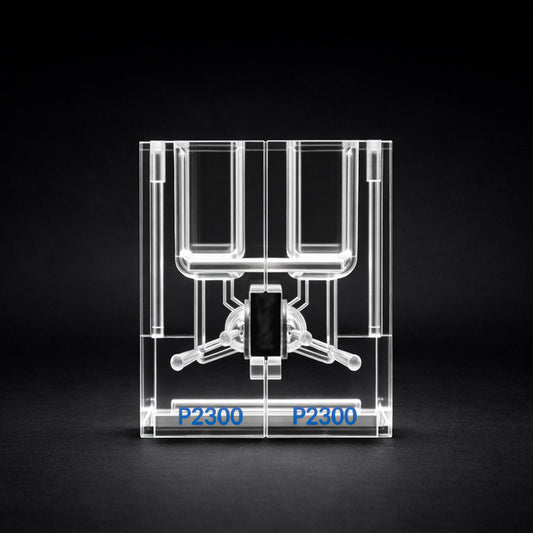

Understanding how ions, nutrients, and therapeutic molecules move across epithelial tissues is central to modern physiology, pharmacology, and biomedical research. Ussing chamber systems are the gold-standard scientific instruments for investigating these processes, enabling researchers to quantify transepithelial transport and barrier function with unmatched precision.
At Physiologic Instruments, we design and manufacture industry-leading Ussing chamber systems trusted by academic laboratories, pharmaceutical companies, and government research institutions worldwide. Our chambers, voltage/current clamps, and data acquisition software are optimized for reliability, sensitivity, and reproducibility—empowering scientists to generate high-impact data that drives discovery.
As a result, this page serves as a definitive resource on scientific instruments Ussing chamber systems for epithelial transport research.
What Is an Ussing Chamber?
An Ussing chamber is a specialized scientific instrument used to measure and characterize the transport of ions and solutes across epithelial tissues or cell layers. By clamping the potential difference across the membrane and measuring resulting current changes, researchers can determine key physiological properties such as:
- Short-circuit current (ISC)—an indicator of net ion transport.
- Transepithelial resistance (TER)—a measure of barrier integrity.
- Electrogenic transport responses—reflecting active transport processes.
Originally developed by Hans Ussing in the 1950s, the Ussing chamber remains a cornerstone of epithelial physiology, now enhanced with modern electronics, automated data acquisition, and modular system designs that support a wide range of applications.
Why Precision Matters in Epithelial Transport Research
Accurate measurement of epithelial transport is critical for understanding normal physiology and disease states. Ussing chambers are central to research in:
- Cystic Fibrosis (CFTR) and ion channel function
- Gastrointestinal nutrient absorption and barrier function
- Pulmonary and airway epithelial transport
- Renal physiology and electrolyte handling
- Pharmacological drug screening and absorption studies
Even subtle errors in voltage or current control can lead to misleading data. That’s why Physiologic Instruments engineers each system with high-precision voltage clamps, ultra-low-noise amplifiers, and robust chamber construction to ensure your data are accurate and reproducible.
Our Ussing Chamber Systems
We offer a complete portfolio of Ussing chamber solutions tailored to different research needs and tissue types:
Ussing Chamber System Comparison
| Model | Primary Use | Typical Volume (per half-chamber) | Compatible Inserts / Tissues | Key Advantages | Learn more |
|---|---|---|---|---|---|
| EM8-C | Cell monolayers & small tissues | ~2–7 mL | Snapwell®, Transwell®, Millicell®; small native tissues | Fast setup; high reproducibility; flexible slider apertures | EM8-C details |
| EM8-LV | Low-volume assays; expensive reagents | ~1–5 mL | Permeable supports; drug flux & permeability studies | Minimal reagent use; rapid equilibration; high SNR | EM8-LV details |
| EM8-R | Large ex vivo tissues (e.g., rat intestine) | ~2–8 mL (aperture-dependent) | Rat/rabbit/guinea pig intestinal tissue; other large epithelia | Robust mounting; custom apertures; temperature control | EM8-R details |
Each system is engineered for optimal temperature control, easy cleaning and maintenance, and compatibility with a wide range of electrodes and sensors.
Voltage/Current Clamp & Data Acquisition
A high-quality Ussing chamber requires more than just the chambers themselves—it depends on precise electrical control and accurate data capture. Our Voltage/Current Clamp modules deliver stable potential clamping and real-time monitoring, while our Acquire & Analyze Software automates data collection and streamlines analysis, eliminating manual errors and improving throughput.
Together, these tools form a complete, integrated Ussing chamber platform built for serious research.
Applications Across Research Disciplines
Our scientific instruments are used in diverse fields, including:
- Basic physiology—characterizing epithelial transport mechanisms
- Pharmacology—testing drug absorption and secretion
- Biomedical research—modeling disease states such as cystic fibrosis
- Veterinary and animal nutrition science—studying nutrient transport
- Toxicology—assessing barrier integrity and xenobiotic transport
Each system is modular and customizable, allowing researchers to adapt their configuration to meet specific experimental needs.
Why Choose Physiologic Instruments?
- Trusted in peer-reviewed research—cited in hundreds of scientific publications.
- Engineered for reproducibility—every system is calibrated and tested before shipment.
- Supported by experts—our technical support team includes scientists with decades of electrophysiology experience.
- Expandable and future-proof—modular components adapt as your research evolves.
Whether you’re investigating epithelial ion transport, screening drug candidates, or advancing translational research, our Ussing chambers provide the precision and reliability required for world-class science.
Related Resources
- Ussing Chamber Protocol: step-by-step fundamentals
- Ussing Chamber Assay: measurements, TER/TEER, ISC
- Ussing Chamber Systems (collection)
- Ussing Chambers (individual chambers & sliders)
Ready to Advance Your Research?
Contact us today to discuss your research needs and discover which scientific instruments Ussing chamber system is right for your laboratory. Our team will help configure a solution tailored to your experimental goals and budget.
👉 Request a Quote | Book a Consultation
Frequently Asked Questions: Scientific Instruments Ussing Chamber
What is a scientific instruments Ussing chamber?
An Ussing chamber is a precision scientific instrument for quantifying transepithelial ion and solute transport across tissues or cell monolayers. It measures short-circuit current (ISC) and transepithelial resistance (TER) under controlled voltage clamp to evaluate barrier function and active transport mechanisms.
What is the difference between an Ussing chamber and a diffusion chamber?
An Ussing chamber is optimized for electrical measurements (ISC, TER) under voltage clamp, while a diffusion chamber focuses on solute flux without electrical clamping. Many labs use Ussing chambers for ion transport and pair them with tracer or permeability assays for comprehensive analysis.
Which Ussing chamber system should I choose?
Choose based on sample type and volume: EM8-C for cell monolayers and small tissues, EM8-LV for limited reagent volumes, and EM8-R for larger ex vivo tissues (e.g., rat intestine).
Do I need a voltage/current clamp for Ussing chamber experiments?
Yes. A low-noise voltage/current clamp provides stable potential control and accurate current measurements—essential for reliable ISC and TER data. See our Voltage/Current Clamp solutions.
How is short-circuit current (ISC) interpreted?
ISC reflects the net electrogenic ion transport across the epithelium under a clamped zero transepithelial potential. Changes in ISC indicate channel/transporter activity (e.g., CFTR, ENaC) or pharmacological responses.
What does transepithelial resistance (TER) tell me?
TER quantifies barrier integrity and tight junction function. Higher TER indicates tighter barriers; reductions often reflect permeability increases or tight-junction modulation during treatment or disease modeling.
Can I work with limited or expensive reagents?
Yes. The EM8-LV Low Volume system minimizes bath volumes, reducing reagent costs while maintaining rapid equilibration and high signal-to-noise.
What tissue types are compatible?
Common preparations include intestinal, airway, renal, and skin epithelia as well as cell monolayers on permeable supports (e.g., inserts). The EM8-C supports inserts and small tissues; EM8-R accommodates larger native tissues.
How do I acquire and analyze Ussing chamber data?
Pair your chambers and clamp with our Acquire & Analyze Software for automated protocols, live visualization, and exportable data with event annotations—streamlining analysis and improving reproducibility.
What are best practices for calibration and noise reduction?
Use symmetrical salt bridges/electrodes, verify zero-offset and series resistance, maintain stable temperature, and minimize vibration/bubble formation. A low-noise clamp and shielded cabling are critical for clean baselines and stable ISC.
Do Ussing chambers support CFTR or ENaC pharmacology studies?
Absolutely. Ussing chamber assays are standard for evaluating ion channel modulators, showing rapid current changes upon agonist/antagonist addition—ideal for CFTR, ENaC, and transporter pharmacology.
Where can I compare systems side by side?
See our portfolio: EM8-C, EM8-LV, EM8-R, plus Voltage/Current Clamps and Acquire & Analyze.